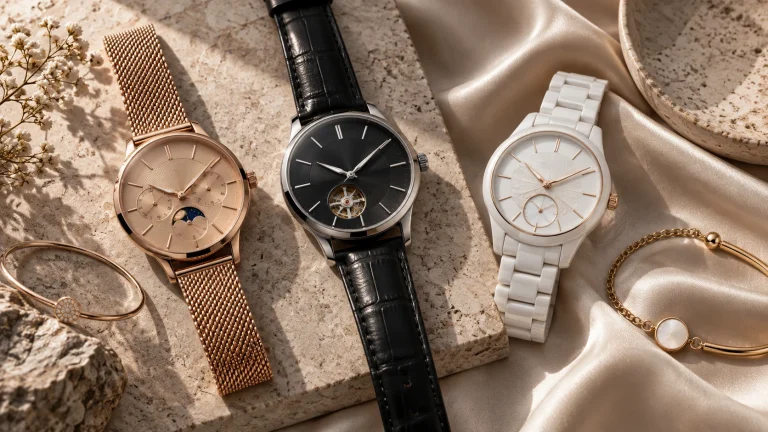
A watch that spins around your wrist can be annoying, while one that presses into your skin becomes uncomfortable by lunchtime. The right fit depends on the band design, case weight, and your own comfort. A leather strap with holes adjusts differently from a metal mesh clasp or bracelet links.
If you are asking how tight a women's watch should be, start with a comfortable wrist measurement and test the watch during normal movement. This guide covers common band types and the signs that an adjustment is needed.
Wrap a soft measuring tape around your wrist at the place where the watch case normally sits. Keep it flat and comfortable, without pressing into the skin. If you do not have a tape, use a strip of paper and compare its length with a ruler.
Record the measurement and compare it with the product's stated wrist range or band length. The strap can be long enough overall yet lack a hole or clasp position where you need it. Case width and thickness influence feel too, so check more than the strap alone.

A well-fitting watch should remain near the top or side of the wrist where you place it without constant readjustment. You should be able to bend your wrist naturally and move your hand without the case digging in. Light movement of the band is normal; repeated spinning suggests it may be too loose.
Remove the watch after several hours. A temporary faint impression is different from painful pressure, numbness, or a deep mark. If your wrist changes slightly with temperature or activity, you may prefer a band with fine adjustments rather than one fixed size.
A leather strap often offers several holes. Choose one that holds the case in place without stretching the leather tightly around the buckle. If your preferred position falls between holes, check whether a qualified watch repairer can add a clean hole; do not pierce the band casually and risk tearing it.
Trysho's GRAYSS square leather watch has a relatively compact face, but the strap fit must still be checked against the listing. A small dial is not proof that a band will suit every wrist.
Some mesh bands use a sliding clasp that can move in small increments. Read the watch's instructions before shifting the clasp, since different mechanisms require different tools and pressure. Once adjusted, check that the clasp locks securely and does not snag clothing.
The POEDAGAR mesh-band watch offers an example of a bracelet-like metal band. Compare the listed length and clasp design with a watch that already fits you. A mesh band that is too loose can let a heavier case swing around the wrist.

A linked bracelet may require link removal or a micro-adjustment in the clasp. Confirm whether links are removable and whether tools or a professional adjustment are needed. Remove an equal number from each side when instructions require balanced positioning.
Trysho's LIGE square ceramic watch has a bracelet-style appearance. Follow its specific resizing instructions; ceramic components should not be treated as if they were flexible metal links.
Silicone bands usually fasten through holes and may feel more noticeable against skin on a hot day. Leave enough room for comfort and cleaning, especially if you wear the watch while traveling or outdoors. Follow the case's actual water-resistance guidance; a washable-looking strap does not mean the whole watch can be submerged.
Trysho's OLEVS 5618 watch combines a silicone band with a decorative dial. Check its band width as well as length, since a broad strap can feel different from a narrow leather one at the same circumference.
Try the watch with the shirts and jackets you wear most. A thick case or wide bracelet may catch beneath a fitted cuff even when the wrist fit is comfortable. A slightly looser sleeve or a slimmer case can be easier than repeatedly pulling fabric over the watch.
Bracelets stacked beside a watch can rub the case and alter how the band sits. If you like a stack, use light pieces with enough space to move without scratching. Wearing a bracelet on the opposite wrist is another option.
If the band is too short, worn, or uncomfortable, check whether the watch accepts replacement straps. Measure the lug width and attachment type; integrated bracelets may not use standard bands. Select a compatible material and closure rather than buying on color alone.
A leather band that cracks or a clasp that fails to lock should be repaired or replaced. Do not rely on an insecure closure just because the watch still looks attractive in a photo.
Measure your wrist, compare the manufacturer's stated range, and test the watch for a few hours at home. It should stay where you want it without pain or constant sliding. The ideal adjustment is the one you can forget about while wearing the watch, not a rigid rule about fitting a particular number of fingers beneath it.