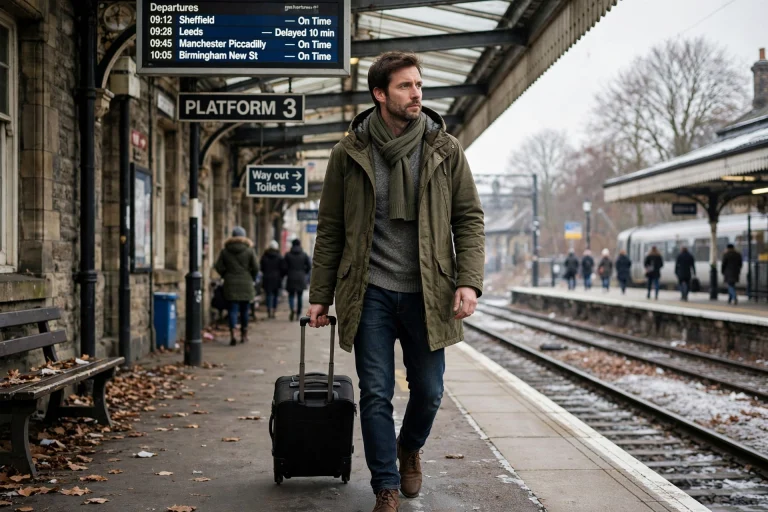
By late November, a light jacket stops being enough. The mornings are darker, the wind finds every gap in a thin coat, and a walk to the station or a weekend trip can turn miserable in minutes. That is when most men narrow the choice down to two proven options: the parka and the field jacket. Both look right, both have a practical history, and both can carry you through winter, but they do very different jobs. Choosing well is not about which one is more fashionable this year. It is about how cold your days really get, how much you carry, and whether you need a jacket for the daily commute, for the countryside, or for both. This guide breaks down warmth, weight, styling and value so you can buy once and wear it all season.
A parka is built for serious cold. It is the longer of the two styles, usually finishing at mid-thigh or just above the knee, and that extra length is its biggest advantage. It covers the tops of your legs, keeps draughts off your lower back, and makes standing on a platform or watching football in December far more bearable. Most winter parkas have a thick insulated lining, a generous hood, and a high collar that closes snugly around the neck. Closure matters too: a two-way zip covered by a storm flap stops wind working its way through the teeth, while ribbed or adjustable cuffs keep the cold out of your sleeves. If your winter means temperatures near or below freezing for weeks at a time, the parka is the honest answer.
The field jacket comes from military clothing, and it still shows its working roots. It is shorter, usually ending at the hip, lighter than a parka, and defined by its four front pockets. Those pockets are not decoration. Many have a removable liner, which makes them useful for longer. You can wear the shell alone on a cool autumn day, add the liner in winter, and layer a jumper underneath when it turns bitter. For men who run warm, drive a lot, or dislike bulky coats, the field jacket often feels easier to live with day to day.

Put simply, a parka wins on warmth and a field jacket wins on versatility. A padded parka traps more air, covers more of the body, and is the safer choice for snow, icy wind and long periods outdoors. A field jacket, even a lined one, will usually need help from layers on the coldest days. Weight follows the same pattern. A field jacket in a sturdy cotton blend or modern technical fabric will shrug off showers and dry faster, but it is rarely fully waterproof unless stated. Think about your routine honestly. A twenty-minute walk at each end of a train journey calls for more protection than a short hop from a car park. Buy for the coldest regular day you face, not the single coldest day of the year, otherwise you will own a coat that feels like hard work for most of the season.
The fear with a parka is looking swamped, but the fix is simple: keep everything underneath slim and tidy. Wear it over a fine-knit jumper or a flannel shirt and straight-leg trousers or dark jeans, and let the parka provide the volume. Avoid wide, loose layers underneath, which add bulk without adding much warmth. Boots suit a parka best, whether smart leather boots for town or waterproof boots for the weekend, because trainers can look lost under a long, heavy coat. Choose colours with care. Black, navy and deep olive work with almost everything a man already owns, and they hide winter grime well. Done this way, a parka looks purposeful rather than padded, and it earns its place as the coat you reach for when the forecast looks grim.

A field jacket is one of the easiest pieces in a winter wardrobe because it sits happily between smart and casual. For work, wear it over a crew-neck jumper, an Oxford shirt and chinos, with leather boots or clean minimal trainers. The structured collar and tidy pockets keep it looking deliberate rather than thrown on. At the weekend, swap the chinos for jeans, add a checked shirt or a plain T-shirt under a jumper, and the same jacket feels relaxed without looking scruffy. Keep the pockets in use but not stuffed: a field jacket that bulges at every pocket loses its shape and its point. Because it ends at the hip, it also works better than a parka when you are driving, cycling or moving between places all day.
Whichever style you choose, try it on, or check the size guide, with winter layers in mind. Read the details closely. Useful features include an inside pocket for valuables, adjustable cuffs, a two-way zip on longer coats, reinforced elbows or shoulders, and a lining that does not rustle or cling. Finally, think about cost per wear.
So, parka or field jacket? Choose the parka if your winter is properly cold, your days involve waiting, walking and standing outdoors, and you want one coat that simply ends the argument with the weather. Choose the field jacket if your days are varied, you layer well, and you want something lighter that works from autumn through to spring. Many men eventually own both, but if you are buying one this season, let your routine decide. Browse the full range in our men’s jackets and coats collection at Trysho, compare lengths, linings and colours side by side, and pick the jacket that fits the winter you actually live in.

TRYSHO
New arrivals & outfit ideas, first — straight to your inbox.
TRYSHO
Welcome to Trysho — here’s 10% off your first order:
WELCOME10
Tap the code to copy it
Use it at checkout — it never expires.
Start Shopping